
• Has your topic been discussed? Check this quick video for search tips. You answer/info might already be waiting!

All 650's 4000 miles of pleasure, now come the real fun part (service maintenance!)

Status
Not open for further replies.

Dankotaru

2019
CBR650R ABS
Jul 5, 2019
7000' ASL, USA
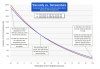
And another chart that might help clear up grade vs viscosity. In this case, it's Castrol synthetic 0W-30 compared to 10W-30. Some people think the '0W' means it's too thin and won't offer good protection. In reality, this oil offers much better protection because it's thicker than their 10W-30 at 100C, while substantially thinner when cold:
1589149171659.png

This is the beauty of a multi-weight oil that offers a high viscosity index (VI). The ability of the oil to stay in it’s grade across a broad range of operating temperatures is known as the oil’s viscosity index. A higher viscosity index number means the oil better maintains it’s weight and tends to be more stable across a broad range of temperatures.

A 5W-30 will typically have a higher VI than a 10W-30. It pumps easier and will build pressure faster than the 10W-30, while also being a grade 30 weight oil at temperature. Thinking a '0W' or '5W' engine oil means it is 'too thin' is a mistake. Oil is always thicker when cold, but these grades are not nearly as thick as the 10W-30 when cold, and can even be slightly thicker at operating temp.
 

baugustine

2014
CBR650F
Staff
May 21, 2016
Ventura, CA
Just to clarify my earlier post, referencing the chart that is posted: the 30 weight designation comes from its testing results at 100 deg C. Ideally, the motor in our bikes would have SAE 30 in it, but to make that work the oil temp would have to be at normal operating temp. Since that doesn’t happen in most places, the oil is further modified to flow correctly and lubricate correctly at lower oil temps (Not ambient air temp, oil temp). A 5W will be thinner than a 10W at lower temperatures, but that is not necessarily better. The bearing clearances and the pump pressure will dictate which winter grade a manufacturer recommends, based on the money they spent testing in development. You can put any grade in you want, but you just need to know what the inherent risks of grade deviation are based on where you live and how you ride.
 

Dankotaru

2019
CBR650R ABS
Jul 5, 2019
7000' ASL, USA
Just to clarify my earlier post, referencing the chart that is posted: the 30 weight designation comes from its testing results at 100 deg C.

Any oil has to have its temperature specified when discussing its viscosity in order to establish its grade, and 100C and 40C are used for the J300 standard for determining oil weight. Here's a good chart:
1589151972012.png

A 30 weight engine oil has a cSt between 9.3 and 12.4 at 100C.

Ideally, the motor in our bikes would have SAE 30 in it, but to make that work the oil temp would have to be at normal operating temp.

I'm not sure I understand the point you're making here, but I don't think you will ever find a tribologist or engineer who would agree with this. A multi-weight oil grade will always be preferable for a four cycle ICE.

Since that doesn’t happen in most places, the oil is further modified to flow correctly and lubricate correctly at lower oil temps (Not ambient air temp, oil temp). A 5W will be thinner than a 10W at lower temperatures, but that is not necessarily better. The bearing clearances and the pump pressure will dictate which winter grade a manufacturer recommends, based on the money they spent testing in development.

Why would it not be better? If the engine is designed to operate with an oil viscosity at 10cSt at 100C (30weight), then anything thicker is more than necessary for proper lubrication. At just 20C, a 10W-30 will have a cSt over 140. That's 14 times the viscosity at start-up on a nice 68 degree F day here in the US. A 5W-30 can have a viscosity around 100 at the same temperature. That's still 10 times the thickness of the oil at 100C, but with 29% less resistance to flow than the 10W-30. Most of the engine's wear occurs at start-up. Faster flow = reduced start-up wear. Hence the benefit of a 0W or 5W oil, and that benefit increases as the temperature at start-up decreases.

You can put any grade in you want, but you just need to know what the inherent risks of grade deviation are based on where you live and how you ride.
I think that's exactly what I'm trying to clear up here.😉

Edit: posted a viscosity vs grade chart for different fluids.
 
Last edited:

baugustine

2014
CBR650F
Staff
May 21, 2016
Ventura, CA
Dankotaru @Dankotaru the weight of the oil is, by defintion, determined at 100C. How it tests at that temp is what it then labeled as unless they make changes to it. Any oil that falls in the testing parameters is labeled a 30 weight. There are some who are espousing different flow characteristics at operating temp. I’m not one of them. I am saying all 30 weights will be virtually the same at operating temp. My point about SAE30 is that would be sufficient if the engine did not have large operating ranges. The multi-grade only is necessary because of cold-weather start-up, where a SAE30 would not perform well.

To come to the conclusion above that you did about 0W & 5W, you have to treat kinematic and dynamic viscocity interchangebly, which you cannot. An oils ability to flow at cold temps is not the same as its internal resistance. They are two sides of the same coin, and both are important for a different reason. If the oil flows too quickly, it will push past the surfaces it is meant to protect.

Pouring a spoon-full of honey into a cup will give you flow rate, but trying to move the spoon in the honey will give you resistance. Both are factored in when a manufacturer tests their engine design with various oils. The overall winner is the one that gets them them the best mileage, best longevity, least resistance and least internal wear.
 

Dankotaru

2019
CBR650R ABS
Jul 5, 2019
7000' ASL, USA
Dankotaru @Dankotaru the weight of the oil is, by defintion, determined at 100C. How it tests at that temp is what it then labeled as unless they make changes to it. Any oil that falls in the testing parameters is labeled a 30 weight. There are some who are espousing different flow characteristics at operating temp. I’m not one of them. I am saying all 30 weights will be virtually the same at operating temp. My point about SAE30 is that would be sufficient if the engine did not have large operating ranges. The multi-grade only is necessary because of cold-weather start-up, where a SAE30 would not perform well.

That's right, a 30 weight engine oil has a cSt between 9.3 and 12.4 at 100C. Any engine oil classed as a 30 weight will have viscosity in that range at 100C. And every one of them will also be thicker than that at colder temps, and thinner than that at warmer temps. For example, the HTHS mentioned in the quote you posted earlier is also part of the J300 standard, and specifies a 30 weight will have a HTHS of at least 2.9. By 150C, that oil has really thinned out. It's because of the change in an oil's viscosity that multi-grade oils will be preferred for just about any lubrication application. Imagine if we had a lubricant that could maintain that 9.3-12.4 cSt at any temperature. That would be awesome. But right now, high VI multi-grade oils are the closest we have to this ideal, and even then, the viscosity change across a temperature range is exponential. So a 5W-30 has less viscosity change across a temperature range than a 10W-30, and that's its benefit.

To come to the conclusion above that you did about 0W & 5W, you have to treat kinematic and dynamic viscosity interchangeably, which you cannot. An oils ability to flow at cold temps is not the same as its internal resistance. They are two sides of the same coin, and both are important for a different reason. If the oil flows too quickly, it will push past the surfaces it is meant to protect.

We'll have to just disagree here, because you don't have to 'treat kinematic viscosity and dynamic viscosity interchangeably' to come to the conclusion that a 0W or 5W provides better lubrication at lower temps than a 10W. And that's not my conclusion, that's just the fact. We can discuss Saybolt measures and centipoise measures (these would be standards for measuring dynamic viscosity) of a 0W versus a 10W to demonstrate this fact, but it seems beyond the point here. The fact is, a 5W-xx oil is never 'too thin' at start-up to provide proper lubrication, as it is many times thicker at start-up than it will be at operating temperature. And that's the point I'm trying to clear up.

Look at it this way: If you have the viscosity of an oil at 100C and it's VI or another viscosity measure (typically taken at 40C), then we can calculate the viscosity at another temp. There are tons of online calculators and toolboxes to do this. If we take a 5W-30 oil and a 10W-30 oil, both from Motul, and they both have the same viscosity at 100C for a 30 weight (11.4 and11.5 cSt, respectively) then we can figure that starting my bike using the 5W-30 at about 14C (57F) the oil is just as viscous as if I started my bike using 10W-30 at 20C (68F). Same viscosity at start-up in both conditions (200 cSt) but suddenly the 5W-30 is now 'too thin' to provide protection, but the same viscosity from a 10W-30 at 20C is perfectly fine? That's nonsense.

Pouring a spoon-full of honey into a cup will give you flow rate, but trying to move the spoon in the honey will give you resistance. Both are factored in when a manufacturer tests their engine design with various oils. The overall winner is the one that gets them them the best mileage, best longevity, least resistance and least internal wear.

An engine oil grade is typically specified by a manufacturer for a number of conditions. Honda recommends a 10W-30. I could speculate why they recommend a 10W-30, but it would just be speculation. What I do know is that it has nothing to do with a 5W-30 being 'too thin' of an oil at start-up. Those using a 5W-30 or 5W-40 will be fine at start-up. In warmer weather it will be darn near the same viscosity at start-up either way, and in colder conditions, they will have better protection than if they were using grades with heavier winter weights.
 

baugustine

2014
CBR650F
Staff
May 21, 2016
Ventura, CA
You can make the argument that a 0W and 5W will flow better at colder temps, I don’t think anyone is disputing that. You can’t say it always provides better lubrication, that is not fact. In order for something to be true, it has to be true 100% of the time. In this case, there are many examples the where the manufacturers had better testing results with something else. If it was that simple, everyone would specify one grade, the oil companies would be happy to make one product and the manufacturer would be even happier.
 

Brammers

2014
CBR650F ABS
Staff
May 30, 2014
Hampshire, England
Riding Since
1993
Let's consider a 10W-30 grade oil. It has the viscosity charicterisitcs of a 10 weight engine oil when cold, and a 30 weight engine oil when hot. If we plot the viscosity of these oils as cSt against temperature, it looks like this:

<chart snipped by Brammers>

You might notice that the viscosity increases exponentially as temperature decreases. This is true of EVERY oil. It is thicker when cold, thinner when hot. The purpose of a multi-weight engine oil is to limit how much the oil thins out with heat. In this case, you can see how the 10W-30 behaves like 10 weight when cold and a 30 weight when hot, but it is always more viscous as the temperature decreases and less viscous as the temperature increases.

Likewise, a 5W-30 is thicker at 20C than a 10W-30 is at 100C. It is not 'too thin' and poses no risk at start-up. Just the opposite, it will lubricate quicker than the 10W-30 in most ambient temps and provide better start-up protection.

So you are essentially recommending an out of grade oil that's too lower viscosity when cold (5W versus 10W), which is when most engine wear occurs?

Right. Remind me never to buy a second hand motor where you've owned it anywhen in the past.

BTW - A 5W30 oil is NOT thicker at 20C than a 10W30 oil (which is why the winter grades are different) you've contradicted your own posts multiple times. They are the same at operating temps (100C) though. I think you're the confused one here, unless you think SAE 5 oil is thicker than SAE 10? You need to stop comparing the winter grades with operating grades as it's illogical.

A 5W oil at old-start (i.e. ambient temps) may get around the engine quicker because it's "thinner"; that does not mean it will lubricate "better" than a 10W (or even correctly) as for previously stated reasons it might be too thin to do the required job at that temp range.

Ergo, the advice of this forum is to run the recommended grades of oil from Honda (who's engineers know more about the oil and the engine clearances than all of us combined, several times over) which is 10w30 or 10w40. Anything else is a gamble that will at best invalidate your warranty and at worse damage your engine (either noticeably or just through faster wear rates on bearing surfaces).

As the OPs question was answered long ago and we're so far off-topic that it's a dot on the horizon I think we should leave it here. Going to lock the thread, feel free to pick up one of the many "which oil" threads if you'd like to continue the discussion.

If we do that, I'll move the relevant post into that thread for consistency.

J
 
Status
Not open for further replies.
Top Bottom