• Has your topic been discussed? Check this quick video for search tips. You answer/info might already be waiting!

All 650's 4000 miles of pleasure, now come the real fun part (service maintenance!)

Status
Not open for further replies.

ghehen

2018
CBR650F ABS
Jun 27, 2019
Vietnam
Ambient temp plays a part for the 10w "cold" grade. Once an engine is running it will be at about 100c (give or take a degree) and the ambient temp only affects how hard the cooling system needs to work to maintain that.

It's not going to alter the "normal" grade thinking at all. Common myth that I partly subscribed to until yesterday.
ah, i got your idea. So at 100c 10w40 will have thicker oil film than 10w30 and we loose power of pumping higher viscocity oil. Glad that 10w40 did not hurt the engine, i'm going to try motul 5w-30 next time to see the diffferent
 

Brammers

2014
CBR650F ABS
Staff
May 30, 2014
Hampshire, England
Riding Since
1993
Careful! 5w30 is thinner at ambient than 10w30... This may cause higher wear rates during startup. I personally would favour 10w40 over 5w30 or 5w40.

J
 

Enrico

2018
CB650F ABS
Mar 28, 2019
This seems to be going round in circles,why not just use the grade of oil Honda recommends for the bike !
 

Dankotaru

2019
CBR650R ABS
Jul 5, 2019
7000' ASL, USA
Careful! 5w30 is thinner at ambient than 10w30... This may cause higher wear rates during startup. I personally would favour 10w40 over 5w30 or 5w40.

J
This isn't correct. A 5W-30 will flow better at most ambient temperatures than a 10W-30, minimizing start-up wear. Especially at colder temperatures.
 

Brammers

2014
CBR650F ABS
Staff
May 30, 2014
Hampshire, England
Riding Since
1993
Actually, the thinner oil could allow bearing surfaces to come into contact causing more wear!

It isn't all about flow.

Machining tolerances in the engine require a certain "thickness" to the oil to work properly as it needs to maintain a film between moving parts.

If the oil is too "thin" it gets pushed out and you get metal on metal = BAD.

baugustine @baugustine a little help please!
 

Dankotaru

2019
CBR650R ABS
Jul 5, 2019
7000' ASL, USA
Actually, the thinner oil could allow bearing surfaces to come into contact causing more wear!

It isn't all about flow.

Machining tolerances in the engine require a certain "thickness" to the oil to work properly as it needs to maintain a film between moving parts.

If the oil is too "thin" it gets pushed out and you get metal on metal = BAD.

baugustine @baugustine a little help please!
It is about flow. The crank main and rod bearings are designed for hydrodynamic lubrication, which requires oil pressure to function properly. The lower the viscosity, the faster that pressure can build between surfaces.

The oil is already many times thicker at start-up than at operating temperature. There is ZERO chance of it being "too thin" at start-up, regardless of the ambient temperature.
 

baugustine

2014
CBR650F
Staff
May 21, 2016
Ventura, CA
The topic of "which oil do I use?" is one of the most hotly debated one on all the Forums I belong (motorcycle, car, truck, etc.). The correct answer starts with "the one the manufacturer recommends". From there we can deviate in lots of directions, with opinions superseding science in many instances.

I cannot share the content from the training classes I will refer to, as I don't own it, but I can paraphrase some of the finer points. If you decide to take issue with it, you will be arguing with Kevin McCartney, who wrote the definitive course on fluids for NAPA, and works as a consultant for several OEMs and Peter Orlando, who is a content creator and instructor for Advance Auto. Disclaimer: the US has very lax "standards" compared to Europe and therefore comparisons across oil manufacturers are difficult because the API is self-certifying. Its just like tire mileage guides, they are only useful within the context of the manufacturer who tested them.

Viscocity has two measurements: (1) Kinematic and (2) Dynamic. Kinematic refers to flow volume over a period of time. Dynamic (or Absolute) is it's measured resistance. They are measured differently and are two different attributes of how it protects and lubricates.

Straight from the source:
The viscosity rating of a motor oil is determined in a laboratory by the Society of Automotive Engineers (SAE) test procedure. The viscosity of the oil is measured and given a number, which some people also refer to as the weight (thickness) of the oil. The lower the viscosity rating or weight, the thinner the oil. The higher the viscosity rating, the thicker the oil. As you will see later, the term weight is really misleading and we should be using the term grade of oil. There are other ways to refer to a fluid’s viscosity. Some of the more common terms are thin, light or low. These terms suggest how a relatively free-flowing fluid such as water flows. Terms such as thick, heavy or high suggest that the fluid demonstrates a strong resistance to flow.

A fluid’s viscosity is important because it is directly related to its load-carrying capabilities. The greater a fluid’s viscosity, the greater the loads it can withstand. The viscosity of a fluid must be adequate to separate moving parts under normal operating conditions (temperature and speed). Knowing that a fluid’s viscosity is directly related to its ability to carry a load, one would think that the more viscous a fluid, the better it is. The fact is the use of a high-viscosityfluid can be just as detrimental as using too light an oil.

Too low (thin or light) = Metal-to-metal contact (friction and wear), poor sealing and increased oil con-
sumption

Too high (thick or heavy) = Increased fluid friction, Reduced energy efficiency, higher operating tem-
perature and equipment starting difficulties particularly at cold temperatures

The key is to select a fluid that is not too light and not too heavy. Fluids (lubricant stocks) thicken as they are cooled. As their temperature continues to decrease, they will eventually reach a point at which they become no longer fluid. As they thicken, their load-carrying ability in-
creases, but their ability to be circulated becomes significantly impaired. As fluids are heated, they thin which reduces their ability to prevent metal-to-metal contact. Therefore, it is important that equal temperatures be used when discussing or comparing the viscosity of fluids and ambient temperature has very little effect on the oils temperature of a warm engine.

All engine oils must deliver in-grade viscosity performance throughout the engine’s operating range. To achieve this, engine oil formulators rely on viscosity index improvers to deliver the required viscosity performance in both low shear and high shear environments while exposed to a wide range of lubricant temperatures – very cold to very hot. The automotive industry has adopted several key tests specifically to quantify an engine oil’s performance over a broad range of temperature and shear conditions. At low temperature conditions, viscosity index improvers must deliver needed viscosity control when low shear is encountered in the oil sump and lines that carry oil from the sump to the engine. Oil that is too thick at
these conditions can cause oil starvation. High shear is encountered in the engine bearings–high viscosities here can result in too much resistance to engine cranking and failure to start the car. The traditional high temperature measurement is kinematic viscosity at 100°C (kV 100°C). This defines the oil’s SAE high temperature grade. High temperature, low shear conditions are seen in leak paths (oil seals, behind piston rings) and too low a viscosity can affect oil consumption. The High Temperature/High Shear (HT/HS) Viscosity test, which is run using oil heated to 150°C, measures viscosity and indicates the oil film thickness that might be encountered in bearings, camshafts, etc. under severe high-speed operations. An oil that is too thin under these conditions may not provide the needed lubricant protection which could result in significant wear in these critical engine parts.

Hydrodynamics is complete separation between primary and opposed body. Hydrodynamic lubrication is where the motion of the contacting surfaces and the exact design of the bearing is used to pump lubricant around the bearing to maintain the lubricating film. This design of bearing may wear when started, stopped or reversed, as the lubricant film breaks down. Hydrodynamic lubrication is maintained when sufficient flow of lubricant is maintained in between two components. During operation, the extreme pressure can squeeze oil out from the two components faster than it can flow in resulting in metal-to-metal contact of the surfaces. It is a double edged sword, that thin oil can flow in faster, but it also gets squeezed out faster. Additionally, thicker oil is harder to squeeze out, but it does not flow into critical areas as quickly. So, correct oil viscosity is critical to proper hydrodynamic wear protection.
 

Dankotaru

2019
CBR650R ABS
Jul 5, 2019
7000' ASL, USA
Looks like another 'prove-you-wrong-athon ' !

This strikes me as an unnecessarily antagonistic interpretation of what could just as easily be seen as an intelligent discussion.

The topic of "which oil do I use?" is one of the most hotly debated one on all the Forums I belong (motorcycle, car, truck, etc.)...
...

For sure. Which is why I don't typically tell someone what oil to use.

Fortunately, one of us has science on our side. I'll leave which one up to the reader to decide.

👍😁

The science works against you. Your statement:
Careful! 5w30 is thinner at ambient than 10w30... This may cause higher wear rates during startup. I personally would favour 10w40 over 5w30 or 5w40.
Is just not correct. And the information Baugustine posted only reinforces this.
 

Brammers

2014
CBR650F ABS
Staff
May 30, 2014
Hampshire, England
Riding Since
1993
I think someone needs to re-read the post he's quoting...

"Too low (thin or light) = Metal-to-metal contact (friction and wear), poor sealing and increased oil con-
sumption".

This makes my point exactly. QED.

J
 

Devilsfan

2018
CB650F
Jun 5, 2019
Tampa, Florida
The topic of "which oil do I use?" is one of the most hotly debated one on all the Forums I belong (motorcycle, car, truck, etc.). The correct answer starts with "the one the manufacturer recommends". From there we can deviate in lots of directions, with opinions superseding science in many instances.

..............

Hydrodynamics is complete separation between primary and opposed body.....So, correct oil viscosity is critical to proper hydrodynamic wear protection.


The only way you'll ever win this argument is to be the FIRST to complain that you're offended. So...I'm offended! I win! :mooning:
 

Dankotaru

2019
CBR650R ABS
Jul 5, 2019
7000' ASL, USA
I think someone needs to re-read the post he's quoting...

"Too low (thin or light) = Metal-to-metal contact (friction and wear), poor sealing and increased oil con-
sumption".

This makes my point exactly. QED.

J

I think you are perhaps confused about engine oil grade versus viscosity. Consider what I said here:
The oil is already many times thicker at start-up than at operating temperature. There is ZERO chance of it being "too thin" at start-up, regardless of the ambient temperature.
If you agree that a thicker oil provides higher film stength and better lubrication than a thin oil, and a 5W-30 is already MANY times times thicker at start-up than when the engine oil is up to temperature, then how do you justify a 5W-30 being 'too thin and causing higher wear rates during startup'?
 

Dankotaru

2019
CBR650R ABS
Jul 5, 2019
7000' ASL, USA
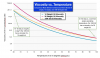
Let's consider a 10W-30 grade oil. It has the viscosity charicterisitcs of a 10 weight engine oil when cold, and a 30 weight engine oil when hot. If we plot the viscosity of these oils as cSt against temperature, it looks like this:
1589148465991.png

I made this chart a number of years ago using BP's conventional G2 base stocks and their 10W-30 Castrol.

You might notice that the viscosity increases exponentially as temperature decreases. This is true of EVERY oil. It is thicker when cold, thinner when hot. The purpose of a multi-weight engine oil is to limit how much the oil thins out with heat. In this case, you can see how the 10W-30 behaves like 10 weight when cold and a 30 weight when hot, but it is always more viscous as the temperature decreases and less viscous as the temperature increases.

Likewise, a 5W-30 is thicker at 20C than a 10W-30 is at 100C. It is not 'too thin' and poses no risk at start-up. Just the opposite, it will lubricate quicker than the 10W-30 in most ambient temps and provide better start-up protection.
 
Status
Not open for further replies.
Top Bottom
